
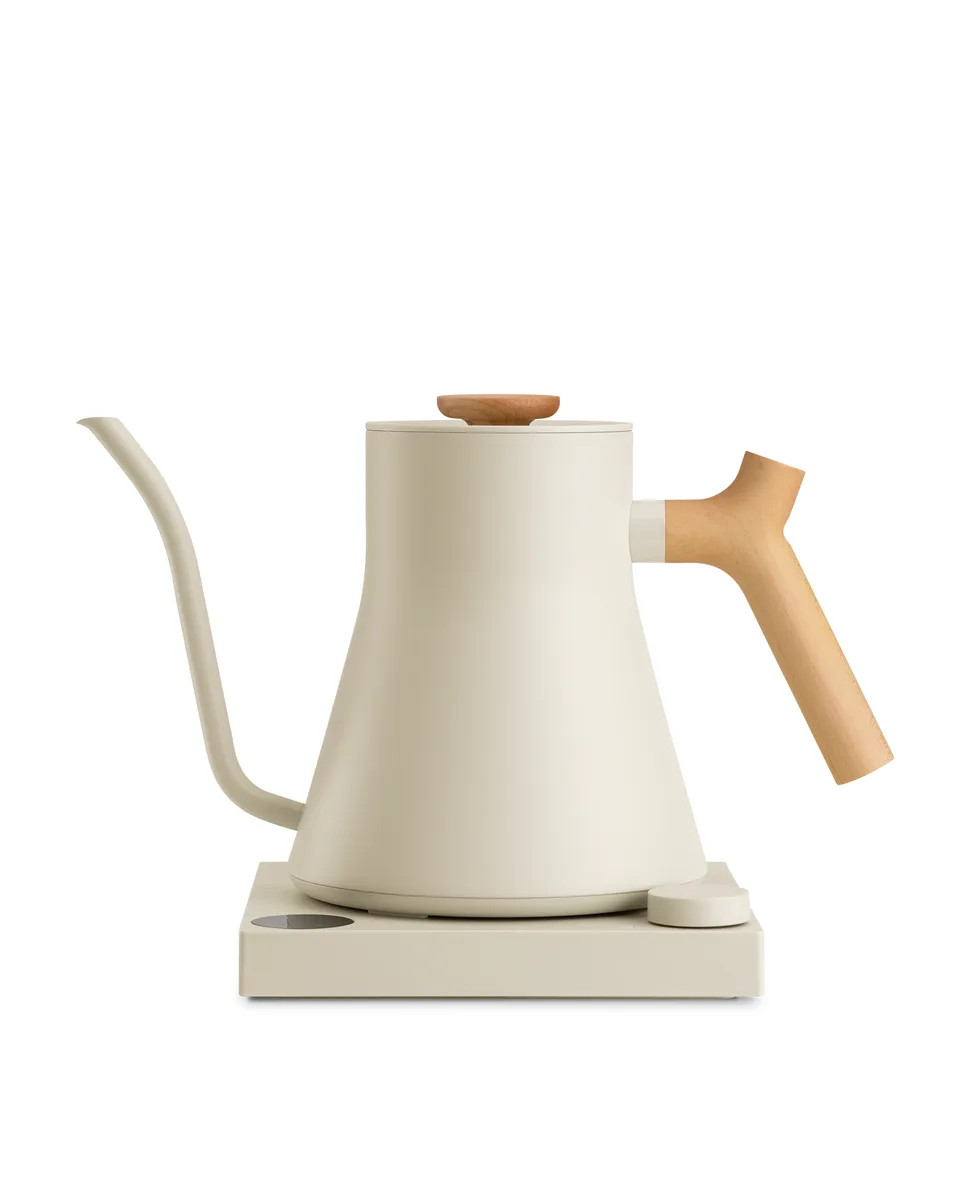
A gooseneck kettle is a kettle with a long, curved, narrow spout. The point is a slower, more aimed pour, which helps when you are filling a small pot, wetting a basket evenly, or pouring over a gaiwan without splashing the table. You do not need one to make good tea. You might want one if your current wide spout is clumsy, or if you already brew in small vessels. This is a buying guide, not a ranked pour-off, and official capacity, wattage, and stove compatibility should be read on the current listing.
Start with the pour, then the plug
Pick up a gooseneck, if you can, and pour water into a cup. You want a stream you can start and stop without a cough of water at the end, a handle that does not twist, and a balance that does not feel like the full kettle will tip you over the sink. A pretty curve that dribbles down the neck is a poor spout.
Electric goosenecks add a base, often a temperature set point, and sometimes a hold. Stovetop goosenecks add nothing to the counter except the kettle, and they ask you to manage heat yourself. That comparison lives in electric vs stovetop tea kettles and in kettles and water temperature. Neither style is automatically more “serious.”
If you already own a temperature-controlled electric with a wide spout, a gooseneck is an upgrade only if pour control is your actual frustration. If you already pour neatly from a stovetop gooseneck, an expensive electric is optional convenience.
Capacity, hold, and the pot you actually use
Buy a kettle whose official useful volume matches how you brew, not a huge vessel you will heat half-empty every morning. Many tea sessions at home want less water than a big household kettle holds. A modest official 0.9–1.2 liter class is a common fit for one or two pots; confirm the real fill line, because a gooseneck’s curved body can look larger than it is.
A hold function is useful for greens, oolongs, and any session where you will pour more than once, including gongfu vs western brewing. It is less important if you boil for a sturdy black and walk away.
Thermometer accuracy is an official or independent-test question, not something we will invent. If you care about a specific set point, a simple separate thermometer can check a new kettle once. After that, consistency is usually enough.
Countertop, cord, and safety matter as much as the spout. A base should sit dry and stable. A stovetop handle should stay usable when the kettle is hot, according to official design — and you should still treat it as hot. Not every stovetop gooseneck is induction-ready; official notes win.
Materials, scale, and care
Stainless interiors are common and sturdy. Some kettles use other official liners or a polished finish that shows fingerprints more than flavor. Scale will form in any of them if your water is hard; a narrow neck is slightly more annoying to descale if you neglect it, but the job is the same. See descaling kettles and water quality.
A gooseneck does not replace a teapot or a basket. It only delivers the water. You still want a vessel with room for the leaf, as in teapots, infusers, and filters. For tasting, a controlled pour makes it easier to fill two cups evenly; see how to taste tea at home.
Current official electric and stovetop goosenecks appear as researched picks in our 2026 list of tea kettles. Match color and capacity to the official SKU; some lines have several sizes and finishes.
FAQ
Is a gooseneck only for pour-over coffee? No. It is a popular coffee tool and a useful tea tool whenever you want a precise stream.
Do I need a built-in timer or an app? No. A hold and a clear temperature control are the features that usually change a weekday cup. Apps are optional.
Why does my gooseneck cough at the end of a pour? You may be tilting too far, filling above a comfortable line, or using a spout design that does that. Practice a slower stop, and do not overfill.
Can I heat tea in the kettle? Heat water in the kettle. Steep tea in a pot, a basket, or a cup. Cleaning tea film out of a narrow neck is a poor hobby.
Choose a gooseneck for the stream and the capacity you will use, then decide whether electric hold or a stovetop burner fits the kitchen. Confirm official stove or wattage notes, descale it, and let the pot — not the kettle — do the steeping.
Features that sound impressive and usually are not
A matching cup on a product page is not a brewing system. A six-color finish line is a preference, not a pour improvement. Bluetooth, a companion app, and a long feature list are optional unless you already know you will use them; they are also more to fail and more to keep updated. A quiet official boil is pleasant in a small apartment, but we will not invent a decibel winner.
A “brew guide” printed on the side of a box is a starting hint, not a law for every tea in your tin. If the kettle has presets named for coffee or green tea, treat them as approximate official starting points and adjust by taste, as how to brew better tea already suggests.
Weight matters if you will lift a full kettle one-handed over a low cup. A heavier electric can feel planted on the base and clumsy in the air. If you can, lift a similar size in a store. If you cannot, read official empty weight and capacity together, and avoid buying the largest model “just in case” if you mostly brew a single mug.
For travel, a gooseneck is usually the wrong first object to pack; take leaf and a basket instead, as in how to travel with loose-leaf tea. At home, the gooseneck earns its keep every morning you would otherwise splash.